Showing posts with label Language Arts. Show all posts

Tuesday, May 31, 2016

Book Bite #6- Surf’s Up


Have you ever met a reluctant reader? Someone who always wants to play rather than read a good book? There is a character just like that in Surf’s Up, a new book by Kwame Alexander and Daniel Miyares.


Bro and Dude’s adventure perfectly illustrates the power a good book can hold over a reader. It’s also a fantastic model of how to use a cliffhanger. Check out our Book Bite for ten ways to use Surf’s Up to jumpstart social studies, science, writing and engineering activities!

Wednesday, September 30, 2015

Magic Spelling Wands

Looking for a fun way to practice spelling words? Have your students make their own magic spelling wand! Give each student a small dowel rod (or wooden skewer with the pointy end clipped off), a star made from cardstock, an index card or thick scrapbook paper, and some ribbon or string. Instruct students to tape the star onto one end of their wand. (You can also hot glue these on in advance for a longer lasting wand.) Then have students pick out some ribbon or yarn to add to the back of the star.
When your wands are finished, use them to write your spelling words in the air. I’ve had students spell the words aloud as they write them and then make a magical twinkling sound as they circle or underline their finished words.

You can use these wands as part of your spelling center, a way to liven up your routine during a spelling slump, or to keep your students spellbound at the end of the year.


Happy Spelling!

Wednesday, September 9, 2015

Easy Writing Pages

A few years our school adopted a new instructional framework that focuses on higher order thinking and writing. Our students have really latched onto this program and are writing more than we’ve ever had them write before.

When some of the assignments got home, they would be slightly difficult to make sense of without the writing prompt, so we had to figure out a way to include it on every student’s paper. At first we tried writing the prompt onto the top of the page but it looked too messy. Then we tried printing directly onto the writing paper so that it would be centered and neat. But a problem arose when my printer broke and was not replaced since we’re going towards centralized printing (yaaaaaaay). When I wanted to print onto the paper I’d have to go into another teacher’s classroom to use her printer or attempt to use the copier to get it onto the writing paper. This usually took 2 or 3 tries after first printing on the back, and then upside down. Cue frustrated sigh.

The problems continued when we realized that, as a grade level, we were going through ream after ream of writing pages and getting close to the end of our supply. So we came up with this idea! We can make our own writing pages that we can type onto and print. We can get the prompt at the top of the page and decide if we want a picture space or no picture space, landscape or portrait, large writing lines or small. What a time saver!!
Here are the writing pages we currently use. We’ve uploaded landscape and portrait formats both with and without picture spaces. These have made our lives much easier and students are really motivated to move on to a page 2, 5, or higher! For easy storage, get some nesting paper trays and store each page number in it’s own bin. Stack them when they aren’t in use, spread them out on a table or the floor when they are. Happy Writing!

Monday, September 7, 2015

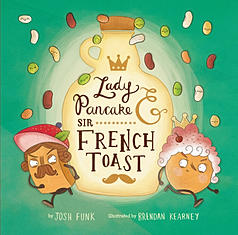
Book Bite #4- Lady Pancake & Sir French Toast

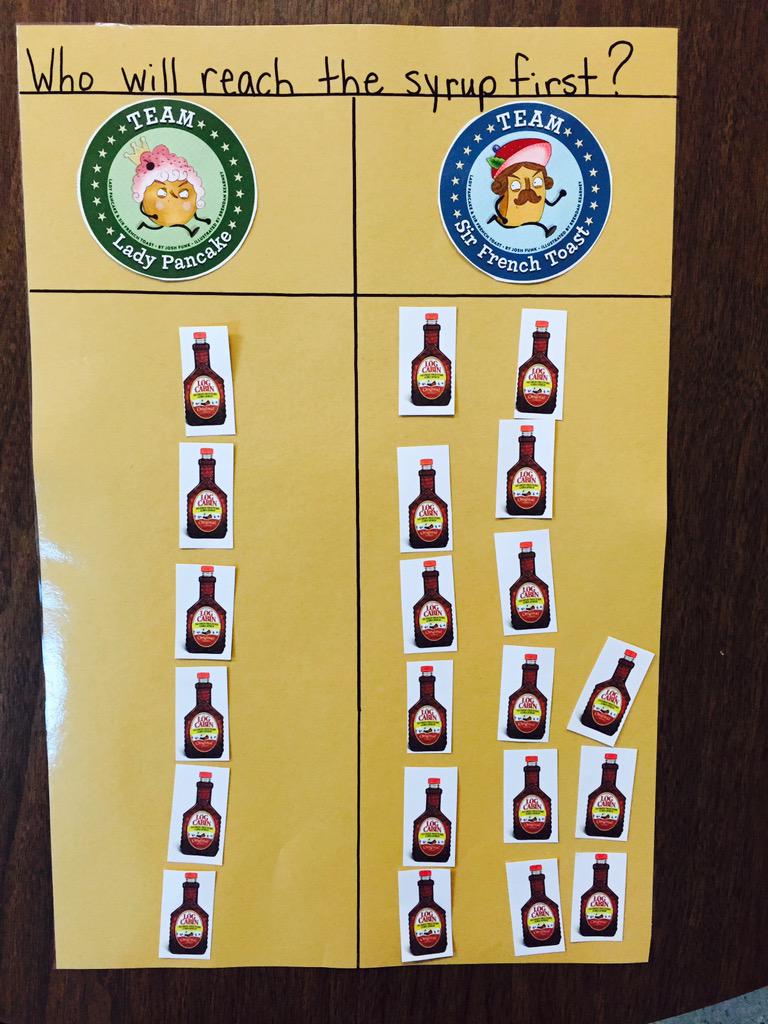
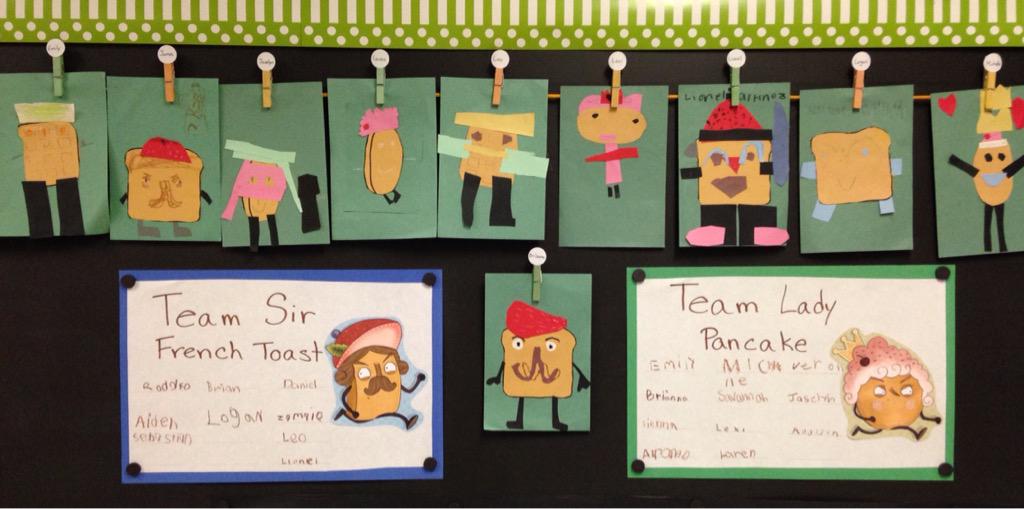
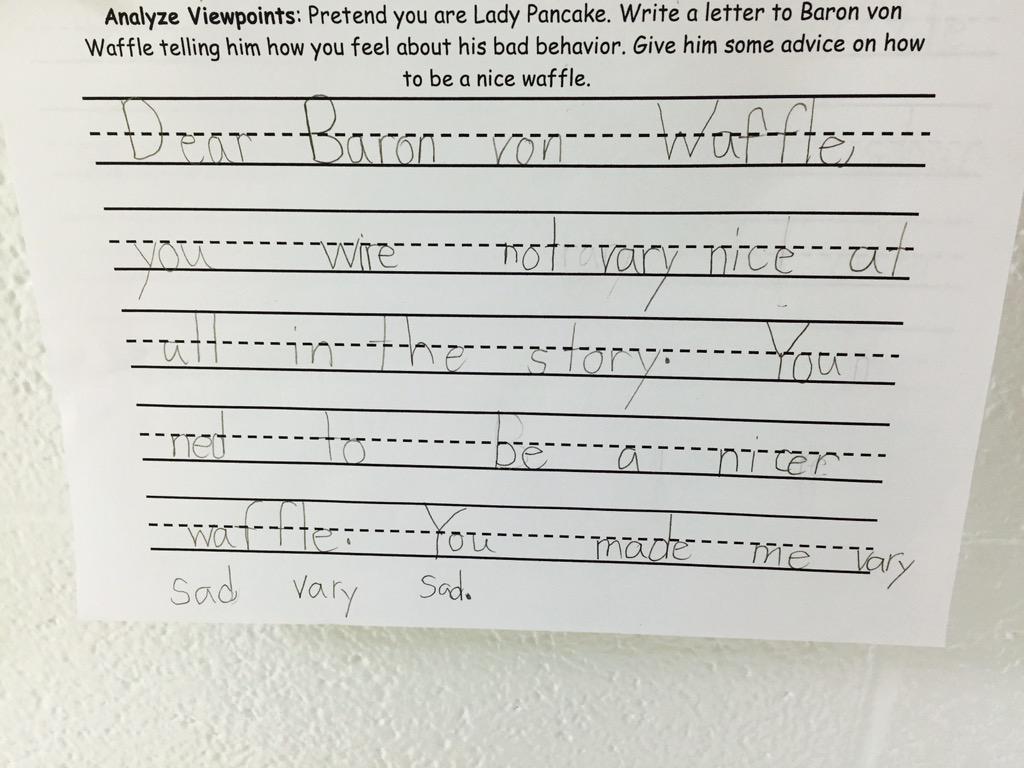
Since our Book Bites for Lion vs. Rabbit, Unicorn Thinks He’s Pretty Great and Sam and Dave Dig a Hole have been so popular, we thought we’d share some of the activities we’ve done for one of our new favorites- Lady Pancake & Sir French Toast written by Josh Funk and illustrated by Brendan Kearney.

You had us at the title, Josh, but then we saw the amazing book trailer. A pancake and French toast battling it out for syrup? Who doesn’t love a little competition? This book proved to be perfect for the beginning of school as we could easily relate it to our citizenship unit. Snag our Book Bite here.
Check out some of the activities we’ve already done!


Monday, August 3, 2015

Everything Journal

Our school used to order planners for each of our students. But what we discovered was that they weren’t really being used like they should have been. So we turned them into “Everything Journals”. By the end of the year each journal was filled with colorful and imaginative responses.

We no longer order planners, so we’ve turned our planner prompts into journal prompts! The prompts can be used in pre-K through third grade classes. Emergent writers can use a mix of illustrations and words or short phrases to respond to the prompts. More fluent writers can respond using sentences or paragraphs. This makes differentiation a snap.


The prompts can be used weekly, or cut apart ahead of time and placed at a writing or literacy center. We have made both color and black and white options that you can choose from depending on your printers and copiers.

The prompts are so varied that our students never tire of doing them.

Saturday, May 2, 2015

Book Bite #3- Sam and Dave Dig a Hole


It’s time for another Book Bite! 
If you enjoyed Book Bite #1 based around Alex Latimer’s, Lion vs. Rabbit and Book Bite #2 focused on Unicorn Thinks He's Pretty Great by Bob Shea, then you’re sure to adore BookBite #3! This time we’ve dug into 2014’s winner of the Caldecott Honor, Sam and Dave Dig a Hole written by Mac Barnett and illustrated by Jon Klassen.
Our students really dug this story. When I asked my first graders to create their own digging adventure from the point of view of the dog, they wrote as many as 7 pages! The words and pictures in this book are sure to illicit smiles, laughter and loud groans of exasperation from kids of all ages. (Do I count as a kid since I definitely laughed out loud when I opened the book?) If you haven’t checked out this book yet, go snag a copy now!

Friday, March 20, 2015

Think about it Thursday

Running out of ideas for ways to kick start your school day? Many schools are encouraging activities that allow more conversations among students; hoping teachers will take a back seat or rather a vow of silence in order to let their students weigh in on issues.

We started “Think About it Thursday” to fill this need. It turned out to be awesome! Each Thursday, we pose a question to our students and give everyone a small copy of the question to glue in their journal. 
They always have an opinion! Some students can’t decide between the choices so they pick both and justify why.

After writing, they insist on sharing. Some students even like to tally the opinions of the class. If time doesn’t allow for whole group sharing, try team share or a buddy share. Have fun! 
Click here for some printables to start you off. If you come up with any good ones, let us know!

Wednesday, March 18, 2015

I Wonder Wednesday

As a kid, I remember having so many random thoughts. Things like “I wonder what my teacher’s pajamas look like,” or “I wonder what fish do all night.”  Most of the time I made up an answer, but sometimes I would try to find the real one. I started “I Wonder Wednesday” with my class to reinforce creativity and inference skills.
Every Wednesday, I give my students something to wonder about. Everyone gets a small copy of the idea to glue in their journal.  We enjoy discussing our thoughts in small groups or as a class. Some students even explore further to try to get answers to things like, “I wonder where all the plastic bottles go,” or “I wonder how chocolate is made.”  Now our week consists of Tell me Tuesday, I Wonder Wednesday, and Think about it Thursday. Lots of higher order thinking going on in first grade!
Here are some of the I Wonder Wednesday printables we like to use.

Tuesday, July 1, 2014

Traveling Library


Each week, my students create class books. They are usually about a subject we are studying or a response to a book we have read. Here are some of the books that we make. Every student contributes a page, we add a front cover and then we staple or bind the book together. Each book is put into the bucket we call our “Traveling Library.” 
Each day as we leave for lunch, we grab the library to take to the cafeteria with us.  When the students finish eating, they entertain themselves with a good book. The rules of the Traveling Library are taped to the outside of the bucket. We use these:
    1.  Choose only one book at a time.
    2. Read quietly.
    3. Take good care of the books.
    4. Have fun!

We add books to the library all year. The students are always proud to publish and enjoy having the chance to read their books every day.

Saturday, April 19, 2014

Can’t Miss April Books


As you're pulling out your books for April, consider adding these to your list. Some are hysterical, others are enlightening and several are just plain enjoyable. Plus we’ve included some ideas for reading follow-up. Let us know if you have some good April books we should be sharing with our classes!


Wednesday, January 8, 2014

Giant Journal


Fee-Fi-Fo-Fum, I smell a way to get writing done! Inspire young writers with an oversized class journal. Bind a large supply of 12X18 story writing paper with staples, metal rings or plastic binding, between cardstock front and back covers. Title the book “Our Giant Journal”.
Add a jumbo pencil and extra-large eraser (both are usually available at craft stores or dollar stores).  Make a gigantic laminated invitation to place on the desk of the student chosen to visit the center each day.
Decide ahead of time what you would like your students to write about. The journal can be for free writing, creating stories about giants or any other class topics. I also leave a basket of books about giants nearby, for peaking interest.


Clipart from: www.mycutegraphics.com

Sunday, December 1, 2013

All the Stockings are Hung with Who, What and Where!


We have been working on story elements and wanted to show what we know in a hallway display. (You could also make this a bulletin board activity.) After reading Fletcher and the Snowflake Christmas, each student completed a stocking, copied on cardstock for sturdiness. I glued thumbtacks to one side of clothespins and inexpensive ornaments to the other side and attached everything to a colorful border.  I also added a sign. If you have the time, you could make a paper chimney/hearth to create a cozy holiday spectacle.


Saturday, October 5, 2013

Fun with Candy Corn


There are so many different kinds of candy corn out there that we just had to create something to do with all of it. Enter this tasty candy corn unit.
Speaking from experience, we find it best to use this as a center. Purchase 3-5 different kinds of candy corn (there are sorting pages and graphs for 3, 4, and 5 included so you can use the one that matches how many kinds you found). These can be found at grocery stores as well as Target and Wal-Mart. Mix them in a large bowl and then distribute evenly (don’t count, just get a visual) into snack size plastic zip bags. At the start of the center, give each student a copy of the packet and a bag of candy corn. To encourage good quality work, we tell our students that the packet has to be checked by the teacher (for accuracy, neatness and overall effort) before any candy corn can be eaten. Not to worry, hardly anyone ever sneaks a candy prematurely because tattle-tails are always lurking and ready to blab. : )


**Here is a mini-poster you can print to hang in your classroom.


Wednesday, September 18, 2013

Short Vowel Apple Trees


September is full of fun things: the smell of new school supplies, less heat and humidity outside, and (possibly my favorite) bright, crisp apples. I love to incorporate apples into as many content areas as possible.

In science we study parts of a tree and seasonal changes as evident in apple trees.

In social studies we discuss the contributions of Johnny Appleseed and examine maps of apple orchards.

In math we explore fractions, graph our favorite color of apples and our favorite ways to eat apples and make patterns.

In language arts we read tons of fiction and nonfiction books about apples. We also love to make our short vowel apple trees. I’ve created 3 different sets of apples to use with various skill levels to help with differentiation. Give your students whichever set you feel is most appropriate. Students color their trees and apples, then cut them out and glue them onto the tree labeled with the correct vowel sound. After they have completed sorting, students glue their trees onto a large sheet of construction paper to create an orchard. When my students finish their orchards they get the chance to earn a special apple treat: a scratch and sniff sticker, a cup of cider, dried apple slices, a bookmark, etc. In order to receive the treat they simply have to read all of the words on their trees. Some practice with peers before reading to me. You could also print these sets onto cardstock and use them as an activity in either small group settings or whole class instruction.


Do you have any fun ways to incorporate apples into your lesson plans?

Erin

Tuesday, August 6, 2013

Back-to-School Mini Units


We spend our summers dreaming up fabulous and sometimes elaborate units to wow our students in the fall. Then, when we go back to school, curriculum maps, required standards and other time-consuming mandates get thrown at us and suddenly the life is sucked out of our once brilliant ideas. Sound familiar?

Since we are rule followers we stick to the maps and standards and teach what we are supposed to teach when we are supposed to teach it. However, we also like to throw in our own creative ideas when time allows. This year, we are trying Mini Units. We chose eight books with strong main characters to use for eight weeks.
Elements we will focus on are: character traits, setting, problem, solution and reflection. We also developed extension ideas for higher achieving students. If you’d like our journal prompts you can snag them here.

Our exploration of these story elements will begin with Fancy Nancy. Throughout the first week we plan to project samples to model each element on our SMARTBoards.


We will begin independent journal entries on week two. Each assignment modeled in week one will be completed in the students’ writing journals (you can see our specific plans here). They will only need to glue in small headings to identify which element we’re focusing on that day. If time allows (ha, ha) we will incorporate other books about the same character into the week. If not, we will at least make the books available for classroom checkout.

If you include Mini Units in your plans this year, let us know how things went for you!